Monday, 21 June 2010

Czechin' out the World Cup in Praha

This weekend I was very excited to travel to Prague, since it was going to be my first visit to an Eastern European city. While the stereotype of Eastern Europe is that everything is run down, Prague may have been the most beautiful city I’ve visited to date. We spent most of our time in the Old Town, which displayed much of the

architecture from the 14th -17th centuries, when the city flourished under King Charles IV and the Habsburg dynasty. It was easy to see on a map where the winding city streets of the Old Town ended and the grid of the New began. Before I visited Prague, I assumed the city was mostly eastern orthodox, since the common (mis)conception is that all of Eastern Europe practices the orthodox denomination. I was surprised to see the abundance of religious relics of varying religions throughout the city, from the majestic 14th century Roman Catholic St. Vitus Cathedral, to the beautiful Jubilee Synagogue, located within the city’s Jewish distr

ict.

Another aspect of Prague that caught my attention was the Czech koruna currency. Currently the Czech Republic is a member of the E.U., but is one of the countries not within the economic union, so it still uses its own money. While the Czech Republic will attempt to enter the monetary union in the future, it was somewhat refreshing to see a currency that is associated with the nationalistic symbols for one specific country. The Czech korunas is one of the most stunning looking currencies I’ve come across, displaying portraits of former Kings and heroes.

While Prague is a city filled with magnificent medieval monuments, but some of my favorite moments in the city were watching soccer at the World Cup Park. Nestled within the impressive baroque and gothic architecture of the Old Town Square, the World Cup Park consisted of an area filled with food, beer (including the original Czech Budweiser), live entertainment, crowds of rowdy football fans cheering on their country, and a proje

ctor playing all the games of the weekend. While we were there, I was able to watch bits and pieces of four different games, Greece vs. Nigeria (Παμε Ελλαδα!), U.S. vs. Slovenia, Germany vs. Serbia, and England vs. Algeria. Watching the matches provided for some of the entertainment, the most interesting part was watching how fans came together to celebrate their teams. As different games ended and a new one started, different hordes of fans would file their way into the park; drunken Englishmen singing “I’m English ‘til I die!”, masses of flag-waving Germans decked out in red, yellow and black, and of course rowdy Americans displaying the red white and blue with pride. It was nationalism at its finest. It was interesting to see how crowds of people, who were most likely strangers before, suddenly became united just by the color of the jersey they were wearing, or the flag they were waving. Although there were many tourists from around the globe watching, there were quite a bit of Czech locals as well. While the Czech national team did not qualify for the tournament, it was interesting to see which teams the locals decided to pledge their allegiance. Due to its close proximity to the Czech border, the Germans received a lot of support, and the Czechs were rooting harder for Slovenia than they were for the United States. While fans from the same country obviously gravitated towards each other during the games, it was interesting to talk with some of the fans around the world to hear there perspective on the games, and their experiences in Prague. Being able to watch the world’s most popular game amongst hundreds of fanatical soccer enthusiasts was one of the highlights of my trip to Prague. While wandering the beautiful city streets was a memorable experience, the hours I spent experiencing the patriotic/nationalistic values soccer brought out was something I’ll never forget.

Czech out Prague


The first step off the metro in Prague was magnificent. The cobblestone streets are still intact, and the buildings survived the world wars. As my friends and I wondered through old town, past the square and clock towers, we found ourselves to be in a different neighborhood. We kept walking towards the hostel, but the buildings became less beautiful, and more modern and run down. Once we found our hostel and settled in, I realized what a difference there was from old town to new town.
Prague is the capitol of the Czech Republic, which it has been called since the breakup of Czechoslovakia in 1993. Just 21 years ago, Prague was behind the iron curtain of the Soviet empire. The city today is one of the most visited in Europe, but it has yet to overcome the socialist past.
After we slept in and got bagels and unlimited refills at Bohemian Bagel , We spent the day walking around the city, across the Vltava River on the Charles Bridge, and walked around the Prague Castle. The city is gorgeous. World War II, which destroyed entire cities like Berlin, did not destroy Prague, as few buildings were destroyed.
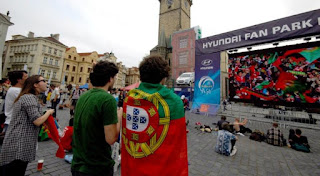
Once we arrived in the center square, the first thing I noticed was not the beautiful astronomical clock that has dominated the skyline since the 15th century but the huge Hyundai Fan Park. The fan park presented by Hyundai consisted of a huge TV screen that aired all of the World Cup games. In-between the USA and Slovenia game and the England Algeria match, we saw “hobos” dancing in the square to techno music. After our obnoxious laughter, I realized that this was not a scene in many European or western cities. Along with the dancing, thousands showed up wearing their flags, jerseys, hats and horns. Although I rarely watch soccer in the US, I found myself chanting “USA” at each good play.
The Czech people do not have a national team in the world cup, but since many countries that border the Czech Republic like Germany do have a team, many still gather in the main square to show their support. Although the world cup is in South Africa and most nations do not have teams, most Europeans still show emphatic support for a nation. The central square of Prague that has been converted into a festival for soccer, food and beer symbolizes the nations hunger for fun and nationalism.
After the games, I became so involved in the architecture around me as we overheard the tour guide; he stated that the Czech government required all newborns to have one of the names inscribed on the clock. I could not imagine the United States having such a law, or if anyone would follow it. Beautiful churches and beautiful bohemian architecture similar to Germany’s Bavaria also surround the skyline of the square.
The city of Prague is a must see for all students. It offers the sights, architecture and history of most European countries, but it is also is a growing economy that has recently been admitted into the European Union. The currency is still the koruna since the government has postponed the adoption of the Euro. Although the currency is difficult to use since every euro is 26 koruna, mostly everything is cheap or affordable. For around 70 euro, 6 people along with myself enjoyed a 5 star Czech meal along with beer and appetizers. For the best bargain’s, move away from the center square, or visit new town to find beer for under one euro. Once I got my money, I received a 20-koruna coin dating from 1993, or the first year the country was called the Czech Republic.
As we left Prague on the very slow train towards Munich, I got a taste of old Eastern Europe. The stations we passed were in disrepair, plants grew from under the tracks, and the communist style apartment block buildings lines in graffiti screamed “Iron Curtain.” It was my only picture of what life was like in the Czech Republic outside of the glamorous life in Prague.
I arrived in Prague knowing that the city had an intense history, like every other European city. Although, the past Soviet influence and the western European world are clashing, the city is thriving in the 21st century, but it is also recovering from the command economy it was under only 21 years ago.

The Impact of Jan Hus

Jan Hus has had a huge impact of the shaping of Prague into what it is today. His two major contributions were to the language and to religion.

Jan Hus, known to us better as John Hus, lived from 1300 to 1415. He was born in Bohemia but moved to Prague to study and later became the leader of the national Czech party. He became a preacher and went on to influence the writings of John Wycliffe. Both Hus and Wycliffe questioned and attacked doctrines of the Catholic Church. They believed in predestination and disagreed with the power given to the hierarchy of the church.

Another one of John Hus’s major complaints against the Church centered around the issue of language. He strongly believed Catholic mass should be given in the local language, or vernacular. He preached in both the Bohemian language and in Czech. He also translated Wycliffe’s work into Czech.

Today, the predominate language of Prague remains Czech. According to NationMaster.com, the percentage Czech is spoken by 94.9% of the country with Slovak being second most popular at 2%. Czech is a Western Slavonic language. Jan Hus greatly influenced the Czech language because he was the one who introduced a series of diacritical marks that change pronunciation and distinguish it from other Western Slavonic languages. One of his greatest contributions to the language was the establishment of the háček into Czech spelling which represents each sound by a single symbol.

It is surprising to me that the Czech language dominates today after learning that is was suppressed for centuries. From 1620 to 1918 the Habsburgs had control over Czech land and forbid the use of the language. This reminds me of the similar situation with Spain. Dictator Franco suppressed and forbade the use of Catalan language. In both cases, the forbidden languages not only survived, but thrived!

English is rapidly becoming the second language and after spending time in Prague, I would agree with this statement. Everywhere I went, whether it was a souvenir shop or clothing store popular among locals, almost everyone I encountered spoke some English.


Hus’ contribution to the Czech language is less well known than his contribution to the evolution of religion. John Hus continued to preach against the Catholic Church, even in 1410, when the Pope banned the writings and ideas of Wycliffe. Huss and his ideas gained many followers, which came to be known as the Hussites. Many Hussites were attacked and even forced to leave the country. John Hus openly attacked the Pope’s sale of indulgences, which caused the Pope to place the city of Prague under a papal interdict. All churches closed and church related activities were banned.

In 1414, Hus was called to the Constance Church Council to be a part of the ending of The Great Schism. Instead, he was imprisoned and tried as a heretic and sentenced to death by burning at the stake. Hus’ death was significant, but not as much as the legend he left behind.

Today, walking around the city of Prague, it is evident the impact Hus made of religion. There are several churches in Prague that were part of the reformation movement led by Hus. The Bethlehem Church has special significance as it, according to our tour guide, is the first Protestant church. John Hus preached here and this where most of the reformative movement took place. There came a point, however, when the Catholicism won popularity in the Czech Kingdom and converted this church into a Catholic one.


After my visit to Prague, it is apparent that John Hus is revered. Understandably so, with his great contributions to religion and the Czech language. There is a huge John Hus monument in the Old Town square. “It shows two groups of people, a young mother symbolizing national rebirth” (http://www.prague.cz/prague-old-town.asp) and victorious Hussites and Protestants who were forced into exile. I find it interesting that this large monument was built entirely by donations in the 1900’s. Monuments are very symbolic and representative, and in this case, it is telling that the monument was not erected by the government or large organization, but by everyday citizens who hold John Hus with high esteem.

Another thing I find interesting is that there is a public holiday devoted to Jan Hus in the Czech Republic on July 6, the anniversary of his death. This, despite the fact that the majority of Czechs describe themselves as non-religious and Catholicism is the dominant Christian religion. I find this ironic since Hus’ ideas stirred such controversy and even war, but today non-Protestants country takes a national holiday in honor of him. This speaks well of the country that move on from such differences in such a respectable way.

Fan Park nation


Walking into Old Town Square (map shown below) in the middle of one of the most beautiful cities in Europe I was taken back by the mass amount of people and activities going on in the enlarged area. Since Dr. Prytherch had spoken of cities putting on a “show” for the World Cup games in the middle of their main squares I knew instantly that it had to be for that. It was called “Hyundai Fan Park Praha.” The first thing I noticed was the huge flat screen and all the people gathered around it, sitting, standing and cheering. This had to be for soccer. In the square, the city had filled the area with food and drinking stands, a stage for live concerts, games for kids and adults of all ages, and the big flat screen. My favorite game that all my friends and I tried was

the soccer “bull.” It was like riding a bull but in soccer ball form. It was the hardest thing to stay on, but the funniest thing in the square to watch people attempt to do. The link listed below goes into more detail about the Hyundai Fan Park in Prague.

After a long day of walking around Prague’s “new town,” we wandered back into “old town” to see what World Cup game was on next. We had made it just in time for the USA vs. Slovenia game and I was so excited to be cheering for my own country along with the other Americans in Prague that day. It was such an awesome feeling to see so many Americans in one place in a foreign city like Prague. Liked we talked about in class last week, it doesn’t matter if you know the players, their scoring record, or even the teams overall winning record, if they’re wearing a jersey for your country, you’re going to take pride in that and scream your head off for that player and team and that’s exactly what I did! There were other insane fans wearing big American flags as capes and there was even one guy wearing American flag underwear. I obviously couldn’t compete with that, but I used my voice instead. My friends and I grabbed a beer and took a seat with all the other people intently watching. Once I sat down and had a good view of the game, I was filled with anticipation and excitement to cheer for the USA. The game was underway and I was getting into it a little more than my friends were. Every chance the USA had at scoring I would tense up and yell and when they did score I was up on my feet high-fiving people around me, jumping and screaming with joy. Soon enough it was tied 2-2 and there was only five minutes left when USA had a corner kick and one of our players came out of no where and slammed it in. That goal was when I knew we had won. Every single American fan and anyone who was cheering for them was standing, yelling, and proudly waving their American flag high in the air. It was definitely a surreal feeling being there at that exact moment in the middle of the city of Prague, watching USA win a World Cup game. After all of the excitement began to settle down, the goal was looked over by the refs and they came to the conclusion that the player who had scored was off sides and the goal was taken away. Of course I was upset at first, but I had to think of the bigger picture and realize that a tie is better than a loss and that I was having an amazing time making new friends with complete strangers and cheering for my country. For more information on the Fifa World Cup, see link below with schedules, scores and other history on this crazy phenomena.

Throughout the game I couldn’t help but think of nationalism and what it means to me. What I and many other Americans were doing that day during the game was how I would define it: taking pride in our team and embracing our identity as Americans and what that entails. Nationalism, according to the article by Foer, is “a battle for nationhood and an ideology that helps create and maintain nation states.” Seeing that game and being there for it was a moment I will never forget. That park will be there for the rest of the World Cup and people from all over the world will sit in the exact same spot as me and cheer for their country and have the exact same feelings that I did. In that way, globalization can also be connected to the World Cup and to that Fan Park in the Old Town Square in Prague.

(Map of Old Town Square)

http://www.fifa.com/

http://www.praha.eu/jnp/en/entertainment/sport/fifa_world_cup_in_old_town_square.html

Czech out the Geography of Soccer and Language

Friday, June 18, 2010: Prague, Czech Republic

This summer has been a particularly exciting time to be in Europe, especially with the 2010 World Cup. One thing I have seen is that Europeans love their football-- a lot. Since I used to play the sport, and because we have been surrounded by it everywhere we've gone, I've become a lot more interested in experiencing the power of football. So it was no surprise that my friends and I stopped when we saw a huge stage, several games (including a mechanical soccer ball), and a giant screen showing the games of the World Cup in the middle of the Old Town Square in Prague.

After walking around the city all day, we decided to sit down among the crazy, avid, and slightly intoxicated football fans on the cobblestone ground and enjoy watching several games of football in the warm sun. It was surreal sitting in the middle of an ancient city surrounded by buildings as old as 1000 years and modern businesses like Starbucks watching the world's most popular sport. As we watched the USA versus Slovenia game, we were overwhelmed by American fans singing national songs and loudly cheering Slovenians, as well as a cluster of other cultures.

Sitting amongst a wide range of people from all over Europe allowed us to experience our lesson in geography last week about the politics of football firsthand. As we discussed, football reveals insights into international conflict, global economics, and politics. The sport is essentially a reflection of the effects of globalization on society. Like Foer says in his book, How Soccer Explains the World: An Unlikely Theory of Globalization, football "gives life to tribal identities in a world where a European Union and globalization are happily shredding such ancient sentiments" like nationalism. People can therefore use football as a way to form a shared identity and a sense of belonging, establishing nationalism. By surrounding myself by a diverse group of people cheering for "their team," I was able to see how the sport allows people to express their pride and loyalty to their country as well as understand how football has infiltrated everyday life all over the world. For more on football and World Cup coverage, visit http://www.fifa.com/, and to learn more about World Cup coverage in Prague, see prague.tv/events/info/world-cup-2010.

As I watched the games on the huge screen, I realized that I had no idea what the commentators were saying-- it was all in Czech. Even though I could not understand a word of what was being said, I still understood the universal language of football. I tried listening to the Czech language to learn a little about it since we have been discussing languages in class as well. After some research, I learned that the Czech language is Slavonic and spoken by about 12 million people (http://how-to-learn-any-language.com/e/languages/czech/index.html). Czech is just one of the many diverse languages spoken throughout Baltic and Easten Europe, and many people of Czech Republic also know other languages. Almost everyeone I encountered in Prague knew English, and I learned that many speak some German because of the country's proximity to Germany and Austria. Additionally, those who grew up during the communist era were forced to learn Russian. Nowadays, many Czechs refuse to speak the language because of its ties to the times of Soviet oppression. Czech is linguistically related to its neighboring country's language, Slovak. However, since Czechoslovakia broke apart on January 1, 1993, the languages are becoming more discernible. It's crazy to think that the language we were listening to while watching football has so much history and meaning behind it.
Listening to the chants, songs, and screams of the people in Old Town Square never got old. It was all so exciting, and I found myself being drawn into the games more and more, as well as the wide range of people watching them. There were lots of people dressed in denim, tons of hilariously drunk dancing hobos, and football fans from all over the place. It was a completely random compilation of people, but it was amazing to be a part of the group watching the World Cup in the middle of Prague. I was only expecting to enjoy some football amongst this group of people, but I ended up learning a lot more.

For more on Prague, its history, and people, visit: http://www.umsl.edu/services/govdocs/wofact2003/geos/ez.html
or http://europa.eu/abc/european_countries/eu_members/czechrepublic/index_en.htm

Wavin' Flag

In the last couple weeks, I’ve visited different countries that are all in the world cup and have experienced watching the games in various pubs and hotel rooms. While being in Prague, I was able to experience my own nationalism by watching the USA vs. Slovenia soccer game in the Prague Old Town Square. For the next couple weeks this square has a “Fan Park” set up with rows of sausage stands, beer on draft, blow up soccer goals and games, and then a huge screen in the middle with whatever game is on. This whole “Fan Park” was put on by Hyundai and was free to watch and play the games. For the two days that we were in Prague we had to pass the Old Town Square multiple times a day and each time we would see a different crowd of people standing in front of the screen in anticipation for the game that was on. We didn’t even have to look at the screen to figure out which team was playing for we could tell from the spirit of the people, many of them had face paint, their flag caped on their backs, and horns constantly making noise. On the second day we passed by and realized that the American flag was flying around, we decided to stop and support our country. The Americans had already sectioned off a part of the square off for standing and cheering, all these fans had USA painted on their face, wearing red, white and blue. I have to admit I don’t really follow soccer or the world cup, and haven’t exactly been interested in watching it until now. As I sat down to rest my legs from walking and watching the people cheer, I began to get more and more into the game, cheering at good plays and joining in with the USA chants, and soon enough I was their to watch the game and cheer, and my quick resting stop turned into a symbol of my nationalism to my country. It seemed like many of the Americans that were touring Prague were all there in the square to watch their homeland play. There not only were American fans but there was a section of Slovenia fans as well. Early when we had passed there were German and Syberia fans watching their game, it amazed me that for each game there were enough fans visiting Prague to take time off to watch their teams play in the city square. As we have been talking about in geography, it seems to me that this world cup, FIFA, is not just a sporting event, but an event that is bringing countries together both internally and externally. Having been sitting in that square not only was I able to share the same American pride with others, but I was able to share that space and interest in soccer with the Slovenian fans and other people watching as well. Seeing how passionate people were getting about the game and showing pride all the way over in eastern Europe made me want to join in on the dedication, made me want to follow the US through their journey in the World Cup and continue to cheer and show my spirit.

FIFA Rankings: http://www.fifa.com/worldfootball/ranking/lastranking/gender=m/fullranking.html
Schedule: http://www.fifa.com/worldcup/matches/calendar.html

Sunday, 20 June 2010

Czech It Out- The Charles Bridge

Flying into Prague adjacent to the Vltava River, more and more sights I had read about before journeying to the golden city became clearer. As Prague flew by in what seemed like seconds, I tried to spot a few of the larger structures I would be visiting in my short time in the city. Only being able to identify two major structures, the Prague Castle and the Charles Bridge, I felt like my mission view the major attractions of Prague would be nearly impossible. My feelings of belittlement were turned around quickly as my journey in Prague took off and I navigated the compact, historical city rapidly and with little effort. My quick journey, however, came to a knee-quivering halt while observing the arguably best view in the city from the majestic, historical Charles Bridge.

As my thoughts on the river drew to a close, I glanced to the hillside and saw the Prague Castle, the second sight I was able to recognize from the window of the plane. Looking at the castle, my previous research of the city again proved useful. The castle, which serves as the seat of the president of the Czech Republic, stands atop a high hill and is a constant reminder of the wealth and power Prague once held on the European continent. Check out this website for great information on the Prague Castle! Originally built as a fortress under the Premysl dynasty,the castle is the oldest structure in Prague and within its towering and seemingly impenetrable walls is the St. Vitus Cathedral, the oldest gothic cathedral in Central Europe. As I gazed up at the castle, I began to get a true feeling of how much history surrounded the city of Prague. I was dumbfounded by how little I had known about Prague before my research and journey to the City of a Thousand Spires. For more on the St. Vitus Cathedral, check out this website with hours of information of the Oldest Gothic Cathedral in Central Europe!


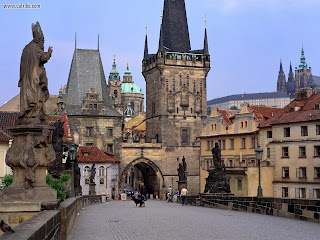
Standing atop the Charles Bridge, I was astounded by the stunning views the bridge offered from the base of the Prague Castle in the New Town juxtaposed with the Astronomical Clock in the Old Town. My feelings of bliss and happiness shifted to a pensive mood as I began to ponder the history of the bridge. From myresearch of Prague before leaving Luxembourg, I knew the bridge was ordered to be constructed by Charles IV who reigned over Prague in the 14th century. Built as a connection, the bridge allowed the city of Prague to expand across the previous boundary of the Vltava River opening up new land to continue developing what, at the time, was the third largest city in Europe. For more information on the history of the Charles Bridge, check out this site!!

Catching the end of a tour guides overenthusiastic sentence about the river, my curiosity was sparked by a fact I heard about Prague being a major hub of slave trade in the 2nd century. After finding my computer and further researching the topic, it turns out the city of Prague grew immensely due to the merchants and traders who moved to the city due its strategic location. With the Vltava River running on the western edge of the present day old city, it was extremely easy for merchants to trade and ship goods around Prague and central Europe which proved extremely profitable and allowed the city to become immensely wealthy.

As my sporadic thoughts about the city and walk across the bridge came to a close simultaneously, I felt slightly overwhelmed by my experience to that point in Prague. With a history spanning thousands of years and encompassing countless wars and power shifts, it is easy to see why the citizens of Prague have so much pride in not only their city but their country of the Czech Republic as well. As Billig explained in his article on Banal Nationalism, nationalism is an unmistakable sense of pride stemming from deep roots in ones country and history. National identity is more than what language you speak or what food you eat. National identity is who you are, and the people of Prague have an immense treasure to show the world exactly who they are.